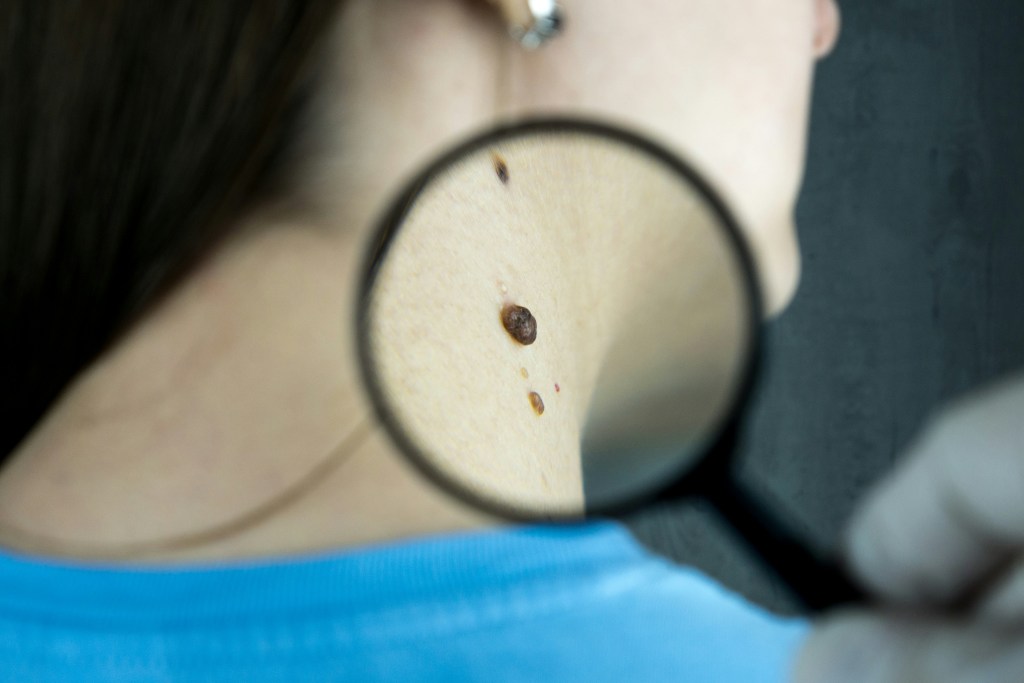
Melanoma is a rare but incredibly lethal form of cancer. Although melanoma accounts for only 2% of skin cancers, it accounts for 80% of skin cancer deaths. How does melanoma develop? Why is UV light so dangerous? What role does genetics play? In this episode we explore these questions and highlight some of the latest targeted therapies for melanoma. Plus, we look at whether artificial intelligence (AI) could help with melanoma diagnosis. Janine also excitedly shares another awesome pun – this time from a thesis title! Plus the Sister Doctor Square gals have been out about town traversing the red carpet. Why? With who? How many drafts of outfits were required? Listen in to hear all about it!
Mastering of this episode, plus intro and outro music, by the ever-talented Dr Adrian Diery.
What is melanoma and why is prolonged UV exposure so dangerous?
Melanoma occurs when melanocytes turn cancerous. Melanocytes are cells in the skin that produce the pigment melanin, which is responsible for skin colouration and skin tanning. Melanin offers some protection against ultraviolet (UV) light exposure.
High and prolonged doses of UV light is dangerous because it can lead to permanent damage to our DNA sequences (aka DNA mutations). These random mutations can lead to cancer if they occur in regions of the DNA that control cell division. When a cell is left to divide uncontrollably, this is how tumorous cancers form (flashback to “Episode 10 – Why is cancer so rare in whales?” if you want to do more of a deep dive into some fascinating cancer research in our cetacean cousins). People with low amounts of protective melanin, either due to inheriting a fair skin type, and/or because their skin has not developed a protective tan, are at higher risk of DNA mutations due to UV exposure, and therefore are at higher risk of skin cancers, like melanoma.
What’s BRAF got to do with it?
Although only 2% of all skin cancers are melanoma, 80% of skin cancer deaths are due to melanoma. Understanding the exact mutations that are involved can really help with developing targeted treatments for melanoma. In their 2023 review paper, Castellani and colleagues focus on one of the most common mutations seen in melanoma patients: the BRAF gene.
The cancer cells of 50% of Caucasians with melanoma display mutant BRAF genes. Mutations in BRAF seem to happen early on in the development of melanoma, so targeting this aspect definitely seems worthwhile. Targeted drugs involve certain inhibitors – some of these can block the crazy cell division that mutant BRAF is driving. They work well for a while in most patients, but then they seem to stop working, as the remaining cells have developed resistance. Hitting the melanoma with a combo of two inhibitors also works well initially, but then we see resistance developing again.
Another complicating factors is that mutant BRAF cells are often able to hide from the immune system – usually the immune system is looking out for, and destroying, abnormal and dangerous cells. Adding specific drugs that help the immune response also seems to help, but again we see resistance develop over time, especially as the cells in a tumor are rarely all the same, so may not all respond in the same way to any treatment.
If you are keen to learn more about how this resistance develops, advances in blood biopsy, and future potential therapies, check out the full review paper.
Could AI help with melanoma diagnosis?
The only way to definitively diagnose melanoma is through a biopsy of the suspicious mark/spot/mole (also called a lesion). But for every melanoma that is diagnosed, dozens more unnecessary biopsies are done; meaning the lesion is found to be normal. We don’t want to do a biopsy every time there is a slightly suspicious lesion on someone’s skin. So, this is why there is an interest in technologies to help dermatologists assess skin lesions without necessarily having to do biopsies a lot of the time.
Marchetti, Rotemberg and colleagues were interested in whether artificial intelligence (AI) might be able to help. In their study, they wanted to validate the accuracy of the ADAE algorithm in diagnosing melanoma and also look at the impact of the algorithm on the decisions dermatologists make when assessing skin lesions. The ADAE algorithm is an open source and non-commercial algorithm (which, incidentally, was the top-ranked algorithm in a 2020 challenge hosted with the International Skin Imaging Collaboration!).
In their study, the ADAE algorithm was found to have a sensitivity of 96.8%. This means of the lesions that were actually melanomas, the algorithm correctly identified 96.8% (also called the “true positives”). The algorithm had a specificity of 37.4%, which means of the lesions that were not melanomas, it correctly identified 37.4% (also called the “true negatives”). The ADAE algorithm actually performed better than the dermatologists at their baseline predictions.
After being shown the algorithm scores, the dermatologists’ ability to assess the lesions improved and their decisions about what they would do next changed in nearly one-third of cases. Importantly, dermatologists’ decisions about what they would do next had higher or equivalent net benefit compared to just biopsying all lesions. What they meant by this was there was as a net positive reduction in unnecessary biopsies after accounting for the harm caused by missed melanomas.
Though some refinements may be necessary, the study suggests this particular AI algorithm can potentially improve expert dermatologists’ ability to assess skins lesions suspicious of melanoma. AI may therefore become a new tool in the toolkit for dermatologists from here!
PSA interlude! How can I monitor my own skin?
As well as making time for regular professional skin checks with a dermatologist, be sure to use the ABCDE acronymn to monitor your own skin:
- Asymmetrical: is the mark/spot/mole asymmetrical?
- Border: does is have an irregular border?
- Colour: are there different colours present?
- Diameter: is the mark/spot/mole getting bigger?
- Evolving: is it changing in any way, like becoming raised, scaly, lumpy, itchy or starting to bleed or weep?
Also watch out for new moles and spots that just look different from your others… Go with your gut!
What brought out our inner square?
Brisbane-based square, Dwan, got in touch to share this *epic* pun from a PhD thesis title!
Taking the ‘poo’ out of ‘pool’: participatory systems modelling as a decision-support tool for even the messiest public environmental health problems.
Currie, Danielle (2019). PhD Thesis, Faculty of Medicine, The University of Queensland
👏👏👏
In this phenomenal thesis, Danielle studied Cryptosporidium in southeast Queensland. Cryptosporidium is a microscopic protozoan parasite that is a significant cause of diarrheal disease outbreaks worldwide. Danielle looked at how this parasite spreads, particularly in public swimming pools, and what can be done to lessen its spread. Danielle tackled things so comprehensively and addresses multiple aspects of disease management. Well done, Danielle! And the thesis is open access, so please do check it out so we can all learn more about how to take the poo out of the pool.
Space/Time movie screening
Meanwhile, Aleena and Janine were very lucky to be invited along to the Cast and Crew Screening of upcoming Sci-Fi feature film Space/Time. They chatted a lot about the film in Episode 23 about Space Junk. In the lead up to the big event, Aleena presented Janine with her “first draft outfit”. Janine was happy to provide constructive feedback: “no edits required”. Check out the girls sashaying across the red carpet on insta! And follow Space/Time movie to stay up to speed with all exciting developments!
Top image by Bermix Studio on Unsplash
Enjoying Sister Doctor Squared?
Please rate and review us in your podcast player!
Sister Doctor Squared is on Ko-fi. If you enjoy listening to the podcast, you might like to ‘buy us a coffee‘ to show your support! All donations go towards the costs of making the podcast and no contribution is too small.
 Sister Doctor Squared